
[Source: BBC News]
Steven Spielberg’s 1977 classic tapped into anxieties about the US government hiding UFO information from the public. It holds the key to the director’s highly anticipated new film, Disclosure Day.
When trailers for Steven Spielberg’s Disclosure Day confirmed that it deals with extraterrestrials, the internet exploded with speculation that it was a sequel to his 1977 classic, Close Encounters of the Third Kind. The guesswork became so rampant that the press notes for the new film cheekily announce it is “not a sequel to Close Encounters (sorry, internet)”.
But it does have very direct ties. Emily Blunt, one of Disclosure Day’s stars, has described it as resembling “a third act” along with Close Encounters and E.T. the Extra-Terrestrial (1982).
Spielberg himself linked the films in one of the trailers, saying, “I’m even more inclined now than I was when I made Close Encounters to really believe that we’re not the only intelligent civilisation in the Universe.”
“Close Encounters becomes an everyman’s attempt to find the truth in the face of massive government secrecy and lies.”
Some of the echoes are obvious, with friendly creatures from other planets arriving here.
But there is a less obvious connection between Close Encounters and Disclosure Day, as both tap into conspiracy theories about the US government hiding evidence of UFOs – or, to use the updated term, UAPs, for Unidentified Anomalous Phenomena.
Those theories go back to the legendary supposed crash of a UFO in Roswell, New Mexico, in 1947, and over the years have only intensified, making their way into the mainstream.
Today, they resonate in light of the Pentagon’s recent underwhelming release of information about reported UAP sightings. Timelier than ever, Close Encounters is a key to Disclosure Day, which is all about revealing the truth about UAPs.
With its bold, expansive visuals, themes of family distress, and the awesome visit of beings from some other planet, Close Encounters holds up as one of Spielberg’s most ambitious and dazzling films. Most viewers are likely to remember at least a few indelible images.
Richard Dreyfuss as Roy Neary, an ordinary family man who sees a UFO, sits at the dinner table building mashed potatoes into the shape of a giant rock.
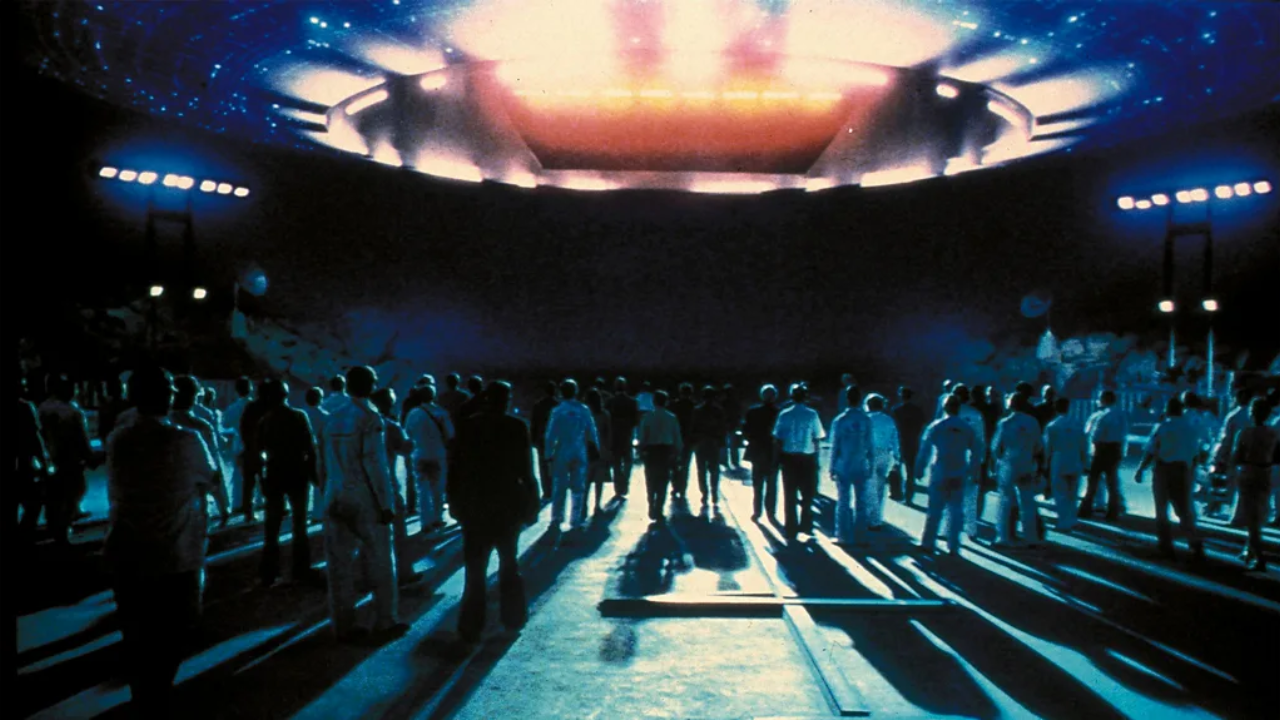
That rock is the site where the UFO will land, although he doesn’t know it yet. One might recall the arrival of the glowing mothership, the spindly, large-headed ghostly-white creatures walking out, and Roy happily joining them on board as he heads off into space.
The five music notes scientists use to communicate with extraterrestrials are hard to forget.