 Litia Cava
More than $1.5 billion in Australian financial commitments under the proposed Fiji-Australia Vuvale Union must translate into measurable improvements for Fiji’s border security and revenue systems.
This, according to Fiji Revenue and Customs Service.
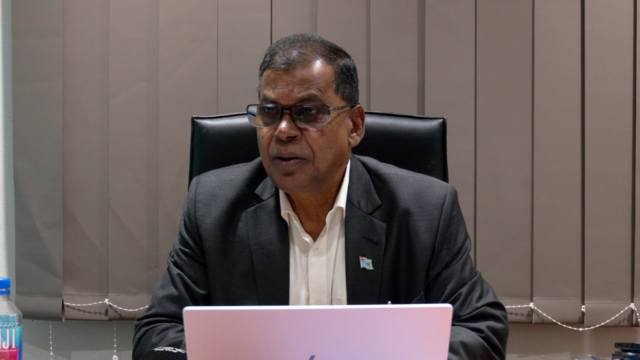
FRCS Chief Executive Officer Udit Singh told the Standing Committee on Foreign Affairs and Defence that funding and equipment alone would not deliver lasting capability.
He said every initiative under the 10-year work plan should have a clear outcome, an accountable owner, a delivery timetable and measures showing its operational benefit.
“Priority should be jointly agreed, aligned with Fiji’s national strategies and implemented through Fiji’s institutions so that capability remains here after individual projects conclude.”
Singh was presenting FRCS’s submission on the proposed Fiji-Australia Vuvale Union and Ocean of Peace Alliance, known as the Veitacini Treaty.
The Australian package announced under the 10-year work plan is worth more than $1.5 billion in Fijian currency. It includes about $1.05 billion in grants and $550 million in loans.
For FRCS, several areas of the package have direct implications for Fiji’s border and revenue operations.
These include $284 million for transnational crime and illicit drugs, $146 million for digital transformation, cyber security and skills, $48 million for economic security and supply chain resilience and $87 million for circular mobility, skills and a new border management system.
Singh said the treaties should be viewed in practical terms because they directly affect how Fiji identifies high-risk passengers and cargo, secures ports and airports, exchanges intelligence and protects taxpayer and traveller information.
He said implementation priorities would be jointly agreed by Fiji and Australia and could change as national priorities develop.
The Ministerial Vuvale Forum and senior officials’ mechanisms would be important in setting priorities, monitoring delivery and resolving issues between agencies, he said.
FRCS is already benefiting from cooperation with the Australian Border Force.
Singh said the existing Joint Forward Work Program for 2025-26 covers maritime capability, intelligence and targeting, cargo screening, trade enforcement, compliance and staff development.