 Reuters
[Source: Reuters]
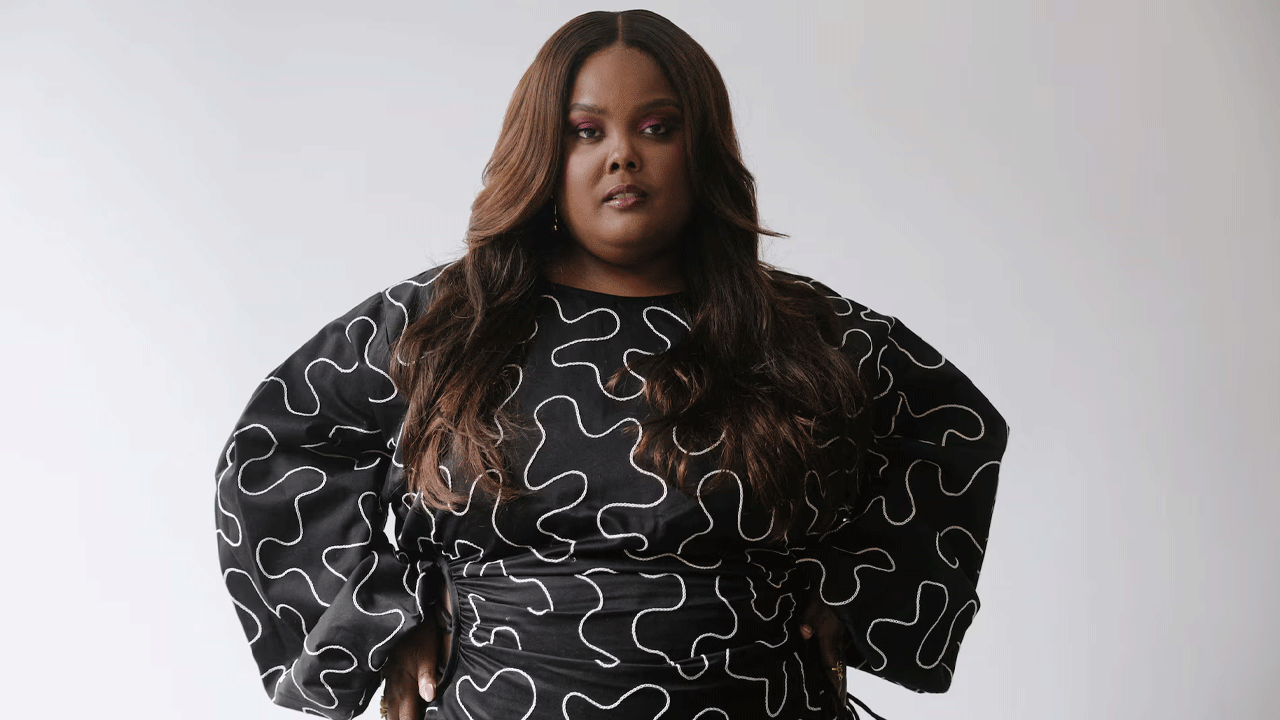
Long before Danielle Pinnock was starring on CBS’s “Ghosts” or sharing the stage with Kerry Washington and Kara Young, she was a teenager riding a bus from New Jersey to Manhattan in search of an artist who reflected the future she hoped to build for herself.
That search led her to the New York Public Library for the Performing Arts at Lincoln Center, where she discovered a recording of “Direct From Broadway,” Whoopi Goldberg’s groundbreaking one-woman show from 1985.
Watching Goldberg disappear into an array of unforgettable characters, Pinnock found proof that she, too, could forge her own path.
That story has come full circle this month as Pinnock returns to Lincoln Center as one of the stars of “The Whoopi Monologues,” helping bring a reworked version of Goldberg’s iconic show back to the stage.
Speaking with Reuters from New York City, Pinnock discusses honoring one of her greatest inspirations, the responsibility of representing her Jamaican heritage onstage and why she hopes audiences leave the theater ready to create legacies of their own.
The following conversation has been edited and condensed for clarity.
You’ve called Whoopi Goldberg your “north star.” What does it mean to help bring “The Whoopi Monologues” back to the stage?
There’s a reason this woman is an EGOT (Emmy, Grammy, Oscar, and Tony Award winner). She is a once-in-a-generation talent. I’m so grateful not only to be in this piece, but to be in it with these incredible actors.
It feels like a beautiful sisterhood we’ve created, and (director) Whitney White has given us such a safe space to try things, tell our stories and connect our own stories to these characters.
You first discovered Whoopi’s one-woman show in the Lincoln Center Library. Now you’re performing this work at Lincoln Center. That’s an incredible full-circle moment.
When I was 14 years old and starting my journey in the arts, I was looking for misfits who reminded me of myself. I was this little nerd in three-piece suits.
I looked like Maxine Waters’ and Steve Harvey’s love child. I had bifocals and cornrows, trying to figure out where I fit.
Seeing Whoopi showed me I could be authentically myself and still be successful.
You’re a first-generation Jamaican American. Do you feel a special responsibility playing the Jamaican Lady?
Absolutely. When I’m doing this monologue, I’m thinking about my mother, my grandmother, my father and their immigration stories — and the difficulties and misadventures they faced coming to the States. I love this character because I get to put my culture at the forefront and do an authentic Patois accent.
I’ve been working with Oliver Samuels, who is Jamaica’s largest, most legendary comedian. He actually flew to New York to help me. I’m telling you, he was training me like Debbie Allen in “Fame.” He was like, “Again. Again.”
“Immigration stories today are often reduced to politics and headlines. This woman gives those stories a human face.”
Danielle Pinnock on her character, the Jamaican Lady, in “The Whoopi Monologues.”
My mom also coached me during the audition process because I wanted to get the Patois right. She was not playing around.
We’d go line by line, and she’d stop me and say, “Nope. Do it again.” Because I’m first-generation, I wanted to make sure I got it down as beautifully as possible.
Even though these monologues were written in the 1980s, they still feel remarkably current. Why?
It’s a testament to Whoopi Goldberg’s writing.
Take my character. Immigration stories today are often reduced to politics and headlines. This woman gives those stories a human face.
She’s funny — she’s a hot mess with a heart of gold — but she’s also dealing with exploitation, survival and hope.
That’s true across all of these characters. They’re funny, they’re political and they’re human. That’s why they still resonate.
Culture Current
Zhang Yueran on why Western readers are finally embracing Chinese stories
Kara Young on Broadway’s ‘Proof’ and the power of stories to transform audiences
Isha Johansen on the promise and politics of football
One of the things I loved about this production is how much the audience becomes part of the show.
The audience is the sixth character. They fuel how every night goes.
The other night I said, “I never saw anybody on TV that looks like me,” and somebody yelled, “Miss Cleo!” I said, “Call me now for your free reading,” and it literally stopped the show for five minutes. People were dying laughing.
Whoopi actually told us, “Don’t be precious about this work.” As a comedian, I love that freedom. It feels like a block party every night. People come to laugh, but they also come to mourn, to learn and to share in each other’s experiences.
You created the solo show “Body/Courage” for your master’s dissertation at the Royal Birmingham Conservatoire in the U.K., for which you interviewed more than 300 people about their relationships with their bodies. What did that project teach you?
That we all are insecure about something.
At that time, I was incredibly insecure about my body and being plus-size. I wondered, “Is anyone ever going to love me? Am I ever going to succeed because of the body I’m in?” What I realized was that I’m actually not alone in this fight.
I interviewed everyone from Olympians to little kids who had been bullied, people who had undergone plastic surgery, sex workers, transgender people, and older adults. I would always ask, “If you had one wish for your body, what would it be?”
And no one ever said, “I just want to be beautiful.”
Everyone said, “I just want to live long.” They hoped that when they were 80 years old, if they fell, they’d be able to get back up.
The other thing that was most powerful for me was seeing how resilient the body is. That project changed my life because it taught me that we’re all carrying something, and that the things we think separate us are often the very things that connect us.
“Body/Courage” changed the trajectory of my career. After I’d interviewed all those people, I turned it into a 90-minute production at Rivendell Ensemble Theater in Chicago, and it sold out every night. Audiences would come up to me and say, “Oh my gosh, I want you to interview my grandma,” or, “Interview my kids.” It became this multiverse in many ways.
And doing “The Whoopi Monologues” has now inspired me to create a follow-up to “Body/Courage.”
What can you tell us about that next project?
I lost my best friend last year. She was my mentor, and it was a kind of grief that I’d never experienced.
The next piece will be about grief and mental health, and exploring what it means to be in mental dysfunction when you’ve strived for perfectionism your entire life or career, and the misadventures of what comes from mental collapse.
What’s the best advice another actor has ever given you?
Viola Davis told me something I’ll never forget.
She said, “Figure out the amount of money you need to make each year to take care of the people who depend on you. If your team can’t get you there, it’s time to find a new team.”
It completely changed the trajectory of my career because it taught me that it’s okay to ask for what you deserve.
What do you hope audiences leave the theater talking about?
I hope audiences leave inspired to create their own legacy, because that’s exactly what Whoopi Goldberg did with this project.
I also want them to leave feeling fed, because this is an offering — not only of Whoopi Goldberg’s work, but of Whitney White’s and the five actors. I want them to feel nourished and excited, and I want them to tell their friends and family to come see the show.
The perspectives expressed in Culture Current are the subject’s own and do not necessarily reflect the views of Reuters News.