
[Source: CNN Entertainment]
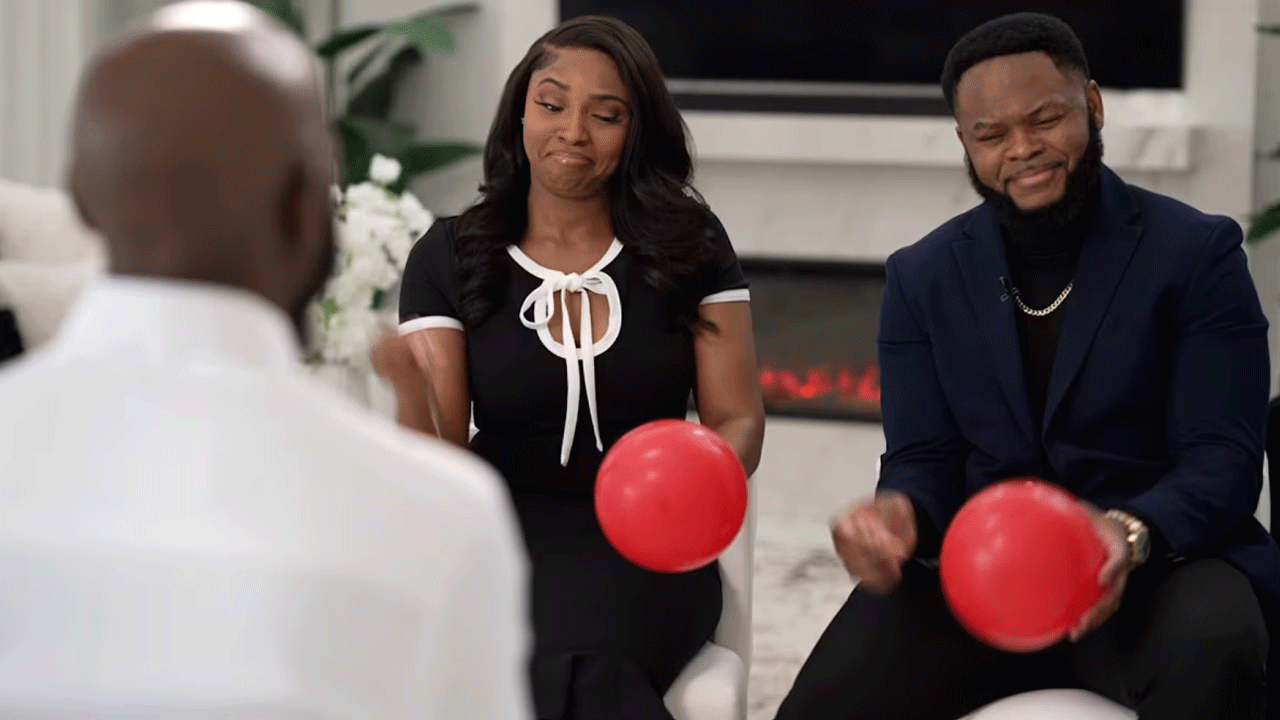
If you’ve spent any time on social media over the last few years, chances are you’ve come across the YouTube dating show, “Pop the Balloon or Find Love.”
The concept is simple. Singles each hold a red balloon while a potential match stands in front of them. If someone loses interest, whether because of looks, values, lifestyle, or something said, they pop their balloon to show they’re out. Sometimes, a contestant is rejected just for their shoes, or a balloon is popped before anyone even speaks. These moments have sparked online debates about modern dating and whether Black relationships face impossible standards.
These moments have helped the independently made show become a global hit. But creators Bolia “BM” Matundu and Arlette Amuli say the viral clips don’t tell the whole story.
“We wanted to make a version that’s meaningful,” Matundu tells CNN. “Real people. Real intentions.”
For the Congolese-born husband-and-wife team, who launched “Pop the Balloon or Find Love” on YouTube in December 2023. They never intended it to be a show about rejection. Instead, they wanted to share a different story, one they feel is harder to find online now.
While social media often highlights conflict, “gender wars,” and dating pessimism in Black relationships, Matundu and Amuli want to focus on something else: Black love.
“When we reached about 10 episodes, I told my wife, ‘We have to really focus on love and storytelling, on people’s real love stories. That’s what will last longer than just viral moments,’” Matundu says.
That shift, they say, has changed the audience.
“In the beginning, people were looking at all the viral moments,” Matundu says. “Now people are actually following the storylines, the true love stories, and that’s what it’s all about.”
Amuli has noticed the same evolution.
“Now, when we have episodes where there are no matches, viewers are upset,” she says.
What started in Arizona with borrowed cameras, one host and contestants recruited through friends — has since become one of social media’s most recognizable dating formats, spawning copycats across the internet and attracting contestants from around the world.
The show’s reach eventually extended to Netflix. In April 2025, the streamer launched “Pop the Balloon LIVE,” an eight-episode live adaptation hosted by comedian and actor Yvonne Orji and produced by Sharp Entertainment. Matundu and Amuli were credited as executive producers, but they say they had little creative input in the Netflix version. Some fans and critics argued that the celebrity cameos, a rowdier vibe, and production changes took away the intimacy and cultural nuance that made the original YouTube series special. Meanwhile, the original version continued on YouTube and expanded into other markets.
Building on the show’s success, Matundu and Amuli have launched “Pop the Balloon or Find Love” editions in the Democratic Republic of Congo in Lingala, a major Bantu language, and in the United Kingdom in English. Despite the different cultures and continents, Matundu says the conversations about dating and the desire to find lasting love have stayed remarkably consistent.
“I’ve done it in Congo, same results. I’ve done it in the UK, same results,” he says. “It doesn’t matter where you’re doing it.”
For Matundu, producing a Congolese version was about more than expanding the franchise.
“I wanted to put our country on the map,” he says. “A lot of people have this image of Africa, and I’m like, no. Africa is beautiful. Africa is amazing.”
The couple also deliberately chose to film the Congolese version in Lingala rather than French.
“It’s not our national language,” Amuli says. “Lingala is our language… so people know this is a Congolese show.”
The Congolese edition quickly developed its own reputation.
“It’s more raw,” Matundu says with a laugh. “People say it’s more rude than the US version.”
Amuli agrees, saying Congolese contestants “will tell you just how it is. That’s how they are in real life.”
As the show has grown, so has the criticism.
Some viewers argue that the viral clips reinforce negative stereotypes about Black relationships by highlighting rejection, superficiality, and conflict.
Matundu believes those conclusions often come from the short clips fans share on social media, where a single rejection or confrontation can reach far beyond the audience that watches the full episodes.
Amuli says those viral excerpts can miss what happens across a full episode: the humor, personal stories, vulnerable conversations and connections that surround the balloon-popping moments.
“There are so many hilarious moments. So many heartwarming moments,” she says. “People tell their life stories… If all you’re seeing are these small clips, you’re not really grasping the full concept of what our show is, which is that we want people to find love.”
Kiaundra Jackson, a licensed marriage and family therapist in Los Angeles who analyzes dating, relationships, and pop culture, says the criticism reveals a kind of tension built into the show. It can both reveal and reinforce attitudes already common in modern dating.
“We already live in a culture where people can be dismissed in seconds, especially because of social media,” Jackson says. “The concern is that when rejection and superficial judgments become entertaining, they can start to feel normal or even acceptable.”
Ironically, the couple says the show’s biggest lesson may be how quickly people judge one another.
Contestants routinely pop balloons based on height, hairstyles, clothing, or first impressions.
“I just wish people would try to look past the outside a little more,” Amuli says.
Jackson says dating apps and social media may encourage the same kind of split-second decisions. While physical attraction matters, she says the problem is when “the first impression becomes the final decision.”
She says that although someone might not at first match your ‘physical type’, attraction can develop after you get to know their personality, confidence, humor, values, beliefs, emotional intelligence, and the way they make you feel.
Matundu believes rigid preferences, not a lack of eligible partners, have become one of modern dating’s biggest obstacles.
“People are living with unrealistic expectations,” he says. “You need to stop acting as if you’re going to find somebody that’s perfect.”
Jackson agrees there is some truth to that. She says standards are fine, but singles can limit themselves by sticking to rigid checklists about what a partner should look like, how much they should earn, what they should have, or what they should have already achieved.
“Sometimes we’re expecting a perfectly packaged person instead of a healthy, compatible human being,” she says. “No one is going to check every box.”
Yet once filming ends, Matundu says, many contestants who rejected one another continue to talk off-camera, and some even begin relationships.
For Jackson, the interactions that occur after the show highlight the limitations of making quick judgments, especially in the high-pressure environment of a televised dating program. She argues that the contestants may be reacting not just to their appearance or to nerves but also to the way the group responds.
“Once the cameras, pressure, and outside opinions disappear, people have the opportunity actually to connect for real,” she says.
To date, they say “Pop the Balloon” has led to four marriages, more than 10 engagements, and dozens of additional relationships, including people who connected after watching the show and then contacted each other through social media.
“We’re changing people’s lives,” Matundu says.
Their own relationship shaped that philosophy.
Before helping others find love on camera, Matundu and Amuli were in a long-distance relationship themselves. Matundu, a Congolese musician raised in London, met Amuli while touring in the United States. He performed in Arizona, and the next day Amuli and a friend, who was a fan, attended his meet-and-greet.
Their first conversation was in Lingala, but Amuli soon learned that Matundu also spoke English. He didn’t pursue her right away, but when she showed up at a music video shoot later, he started to see her differently.
After Matundu returned to London, they FaceTimed daily. Two weeks later, he went back to Arizona for a few weeks and asked her to be his girlfriend. Seven months after they met, they got engaged.
“I don’t have time to waste,” Matundu says. “When a man knows, he knows.” Now, they are married, have a daughter and run a business together.
Their newest venture, the dating and social app Luv or Pop, is designed to encourage intentional dating. Unlike many dating apps, once users match, their other conversations are paused until they decide to “uncouple,” creating a more focused connection.
“It’s about intentionality,” Amuli says. “We want people who are serious.”
For the couple, both the app and the show have the same goal. They want to encourage people to slow down, look past first impressions, and believe that real relationships are still possible.
This message feels especially important to the couple, since much of the online dating conversation now shows relationships between Black men and Black women as more hostile, or suggests that people should look outside their community for partners.
Jackson says social media can make that divide appear larger than it actually is.
“Conflict gets clicks,” she says, pointing to the prominence of posts pitting Black men and women against one another or declaring that someone will never date within their race again. Those conversations, she says, can receive more attention online than examples of healthy Black relationships and marriages.
It doesn’t mean that the frustration is completely artificial. She says that she has witnessed people becoming discouraged as a result of their dating experiences and, on a personal and professional level, has noticed an increasing number of people extending their dating beyond their race.
Matundu, however, rejects the idea that Black singles need to give up on finding one another.
“I think our show indicates that Black love is not dead,” he says. “People are always saying, ‘Go find somebody somewhere else.’ But there are plenty of single Black women and single Black men out here. They come on our show. They meet each other.”
Amuli hopes that’s ultimately what viewers take away: not the popped balloons or viral one-liners, but the possibility of connection. “There are still people out there looking for love within our community,” she says. “Let’s keep pushing for it. Let’s keep trying… Don’t let it die.”