 Reuters
[Source: Reuters]
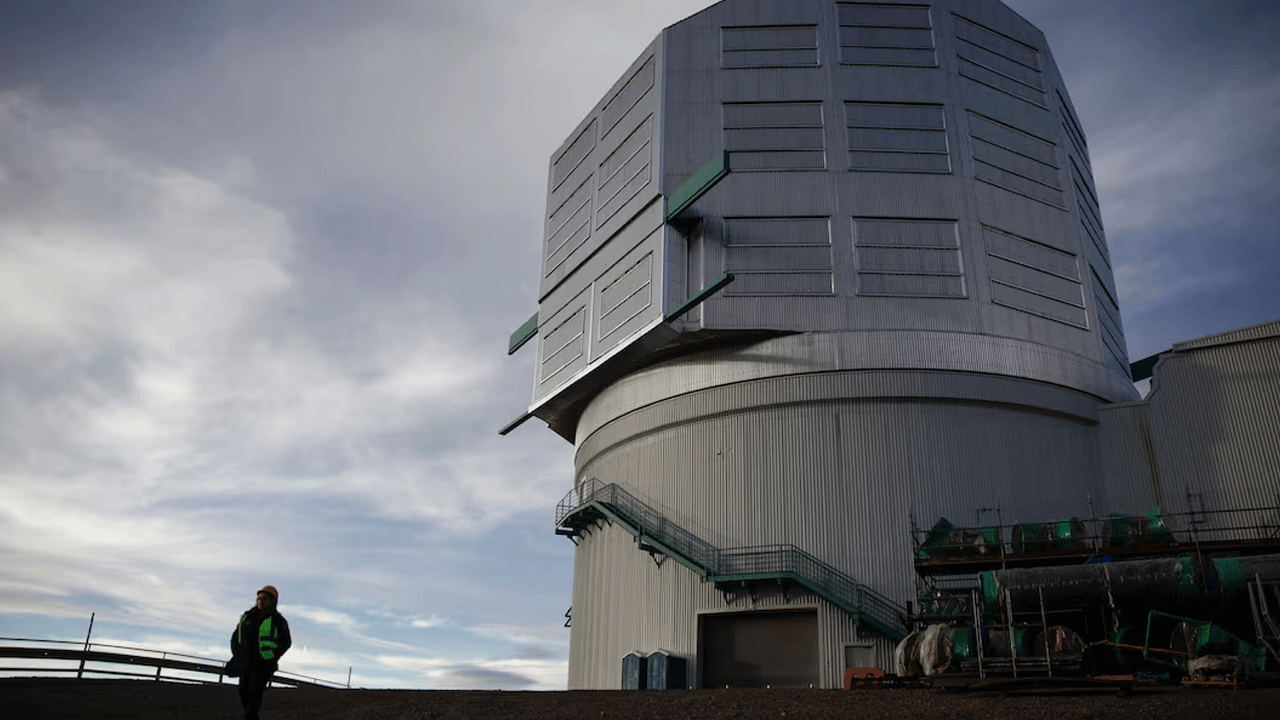
Perched atop a mountain in Chile’s Coquimbo region, where some of the world’s darkest skies stretch over the Andes, a giant observatory has begun filming the infinite to create the first movie of the universe.
The Vera C. Rubin Observatory, a joint program of the U.S. National Science Foundation’s NOIRLab and the U.S. Department of Energy’s SLAC National Accelerator Laboratory, officially launched its decade-long survey of the night sky on June 29.
Equipped with a massive 3.2-billion-pixel camera, the facility will photograph the entire visible southern sky every three to four nights, generating a constantly updated record of cosmic change.
“Rubin is a new way of really looking at the universe,” said Stuartt Corder, mission scientist for AURA in Chile and deputy director of NOIRLab.
“It’s providing a sort of a movie of the night sky instead of snapshots of small parts of the sky, which is how traditional astronomy has been done.”
Rubin will repeatedly scan vast portions of the sky, tracking how stars, galaxies, and other objects evolve over time, which Corder says will give a dynamic view of how measurements and objects are changing.
Astronomers will be alerted when a star explodes, an asteroid passes nearby or an unfamiliar object suddenly appears, and be able to track it.
Researchers also hope Rubin will help unravel some of the universe’s biggest mysteries, including gathering more information on dark matter and dark energy, while also creating a “census” of objects in our solar system and the galaxy.
Corder expects the observatory to help scientists observe more asteroids from other solar systems and provide a deeper understanding of our own.
“We’ll really get an understanding of maybe what is the difference in composition of our solar system as compared to other solar systems from these rocks that just happened to be flying through because they got thrown out of their solar system,” Corder said.