 Reuters
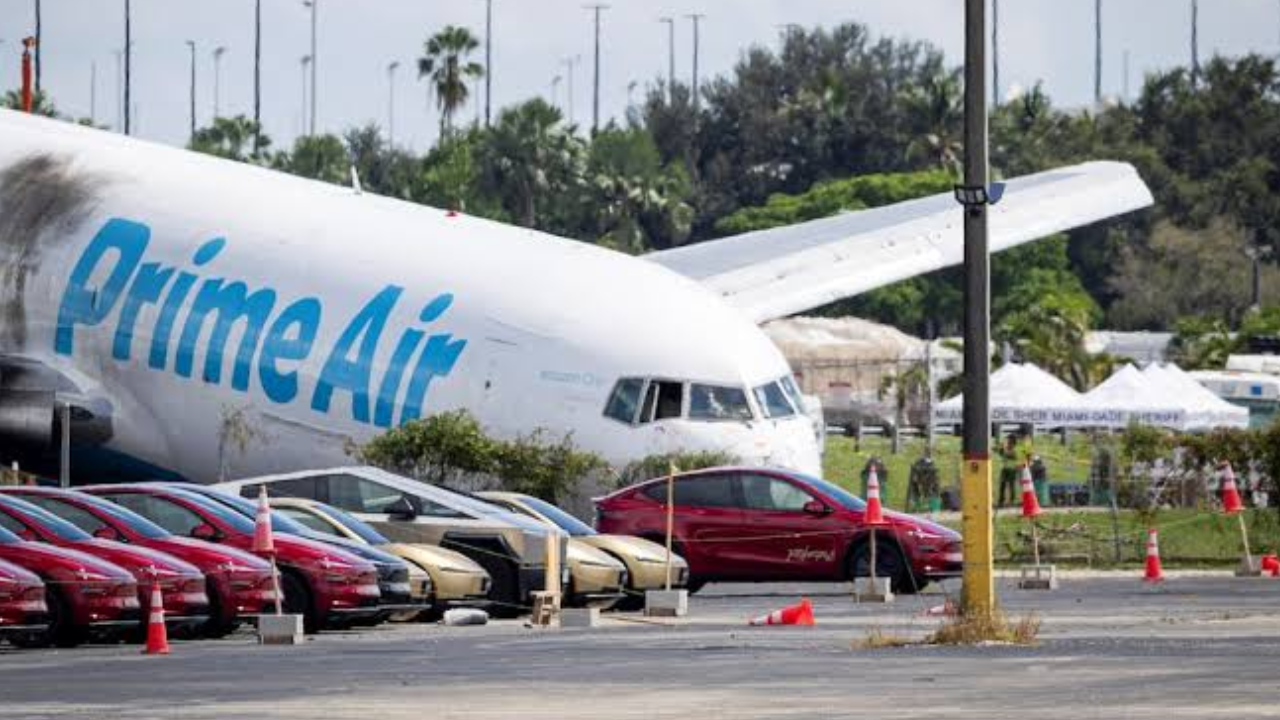
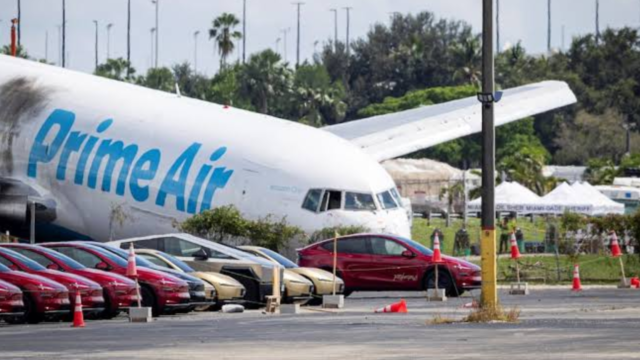
Tesla cars are parked in a lot next to where a crashed Amazon Prime Air cargo plane came to rest, where airport officials said it overran a runway at Miami International Airport. [Photo Credit: Reuters]
The National Transportation Safety Board said on Tuesday that evidence recovered from a flight data recorder suggested the pilots of an Amazon Prime Air cargo plane involved in a deadly crash considered aborting the landing after the aircraft touched down.
The 32-year-old Boeing (BA.N), opens new tab 767 operated by Miami-based 21 Air overran the runway by some 1,300 feet (396 m) and crashed into two vehicles, opens new tab, killing five people and injuring five others on Sunday.
NTSB Chair Jennifer Homendy told reporters that investigators would interview both of the pilots on Wednesday and then release details from the cockpit voice recorder.
The NTSB said 30 seconds before the end of the flight data recording, the nose landing gear and right main landing gear touched down on the runway at a speed of 158 knots (181 mph), while 19 seconds before the end of the recording, the left main landing gear touched down at a speed of 134 knots.
A few seconds later, the brakes were released and the throttles were increased to values consistent with go-around thrust, indicating a late attempt to abort the landing and get back in the air.
But 11 seconds before the end of the recording, throttles were reduced to idle power and brakes were reapplied. The final ground speed was 65 knots at the end of the recording.
The NTSB said there was no indication in the recorded data that speed brakes or thrust reversers were deployed to help slow the plane.
Homendy is leading a team of 32 investigators at Miami International Airport. She said the NTSB was able to release one of two runways closed since the accident to allow for departures from an easterly direction late on Tuesday.
The Amazon cargo plane was on its third flight of the day, coming from San Juan, Puerto Rico. It had flown from Cincinnati to Miami and from Miami to San Juan earlier on Sunday before the crash at 1:53 p.m. EDT (1753 GMT).
The captain, 55, received his type rating for the 767 in May and has 7,145 hours of flight time, while the first officer, 37, received his type rating on the 767 in April 2025 and has 2,655 flying hours, the NTSB said.